
Jewellery shop software is usually bought for one reason — the daily bill book has stopped being enough — but the shops that get real value out of it are the ones that picked something built to grow with them, not just print a faster receipt. A single-counter store and a three-branch retailer don’t need the same tool on day one, but they often end up needing the same underlying system, because the second branch always arrives sooner than the owner expects. This piece is written for that in-between stage: not a brand-new shop, not yet a chain, just a jeweller trying to figure out what actually belongs on the counter in 2026.
Why a Bill Book Stops Working Long Before You Notice
Most jewellers don’t switch to software because of one bad day. It’s a slow accumulation — a rate quoted wrong during a busy Saturday, a customer’s exchange history that only the senior staff member remembers, a mortgage entry that got missed in the register and surfaced three months later as a dispute. None of these feel urgent individually. Together, they’re the reason jewellery billing software exists in the first place: not to replace a good salesperson, but to make sure the shop’s memory doesn’t live in one person’s head.
A shop running on paper can survive for years. What it can’t do is scale, hand over cleanly if the owner is away, or produce the kind of records a bank or a GST officer wants to see without a week of reconstruction.
What Actually Counts as Jewellery Shop Software (Not Just Billing)
A lot of what’s sold as “jewellery software” in India is really just a billing screen with a gold-rate field bolted on. That’s not wrong, exactly — it’s just incomplete. Proper software for jewellery shop operations covers a few things working together, not in isolation:
- Daily gold, silver, and diamond rates, updated karat-wise, applied automatically to every bill
- Barcode-based billing with making charges and GST calculated without manual entry
- Customer records that carry order history, exchanges, and mortgage or RD accounts
- Real-time stock, so “how much do we have in 22K bangles” has an actual answer
- Reports that export to Tally instead of getting re-typed at quarter-end
If a system is missing more than one of these, it’s a billing tool wearing a management label.
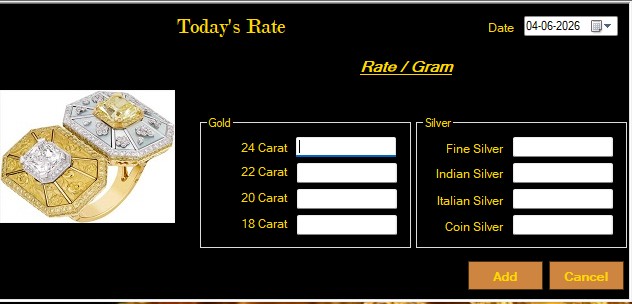
Our gold/silver rate management interface
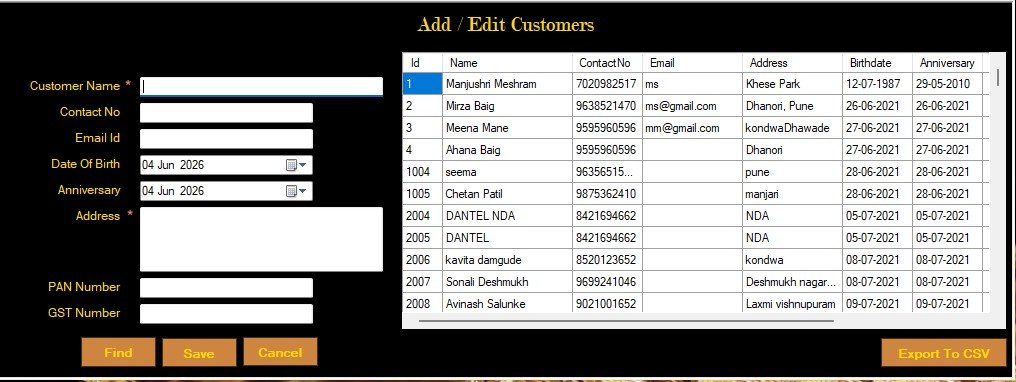
Our customer records interface
The Features Small Retailers Actually Use Every Day
Not every feature on a spec sheet gets touched daily. For a single-counter or two-counter shop, day-to-day use narrows down to a handful of screens:
| Feature | What it replaces | Why it matters daily |
| Barcode billing | Manual weight and rate calculation | Cuts a 6–8 minute bill to under a minute |
| Live rate updates | Chalkboard or WhatsApp rate broadcast | One rate, applied consistently, no mid-day disputes |
| Customer ledger | Register or memory | Old-gold exchange and order history in one lookup |
| Stock by category | Physical count | Answers “what do we have” without closing the counter |
| GST/Tally export | Manual re-entry at filing time | Quarterly filing becomes a same-day task |
This is the core of any decent jewellery store management software — the parts a shop touches before lunch, not the parts a brochure leads with.
What Changes Once the Shop Starts Growing
The features above cover a single counter comfortably. Growth changes the questions. A second branch means stock has to be tracked location-wise, not just item-wise. Taking on wholesale or supplying to other retailers means purchase orders, karigar tracking, and manufacturing records start to matter. Trading in bullion — buying and selling gold or silver by weight rather than by finished piece — needs its own stock and settlement logic entirely.
This is where a lot of shops discover their billing software was never built to grow with them, and switching systems mid-expansion is far more disruptive than choosing the right one at the start. A proper jewelry retail management system should be able to absorb a second branch without a rebuild — and if the business eventually moves into wholesale or bullion trading, the same provider should already have those editions built, not promised.
Jewellery Shop Software vs. Generic Retail or Accounting Tools
It’s tempting to run a jewellery shop on a general retail POS plus Tally on the side. It works, until it doesn’t:
| Generic retail POS + accounting software | Purpose-built jewellery shop software | |
| Rate handling | Manual entry per item | Karat-wise auto-calculation |
| Old jewellery exchange | Not supported | Live rate-based valuation |
| Mortgage (Girvi/Gahan) | Not supported | Built-in EMI and interest calculation |
| RD schemes | Not supported | 11-month scheme tracking with 12th-month bonus |
| GST on making charges | Manual configuration | Jewellery-specific by default |
Generic tools aren’t badly built — they’re just not built for this trade. Jewellery software for retail operations needs to speak the language of karats, making charges, and Girvi/Gahan out of the box, not as a customisation request six months in.
What to Check Before You Buy
A short checklist, worth going through with any provider before signing anything:
- Does it handle rate changes mid-day, not just once at opening?
- Is mortgage and RD management built in, or is it a separate module sold later?
- Can it export directly to Tally without manual re-entry?
- What’s the actual onboarding time — days or months?
- Is support local, with someone who can visit the shop if something breaks during a busy season?
- Can it grow into wholesale or bullion editions on the same customer and stock data, if the business ever needs that?
Shops that skip this list tend to end up back at step one within two years, having outgrown whatever they bought in a hurry.
How Cloudazia Systems Builds Jewellery Shop Software
Cloudazia Systems has been building jewellery-specific systems since 2016, and the retail edition is designed around exactly the daily-use list above rather than a long feature sheet that never gets touched. On a typical shop, billing that used to take five to ten minutes manually comes down to under a minute with barcode scanning, and most stores are live within one to two weeks of placing an order — training included, not sold as a separate line item.
Because the same platform also covers wholesale and bullion operations, a retailer that starts on the retail edition and later opens a second branch, takes on wholesale supply, or starts trading bullion doesn’t need to switch providers — the data and the relationship carry over.
See the full feature set on the jewellery management software page, or go straight to the retail jewellery management software page for the edition built specifically for single and multi-counter retail stores. If you’re still comparing providers, our guide on how to choose jewellery management software walks through the same checklist in more depth.
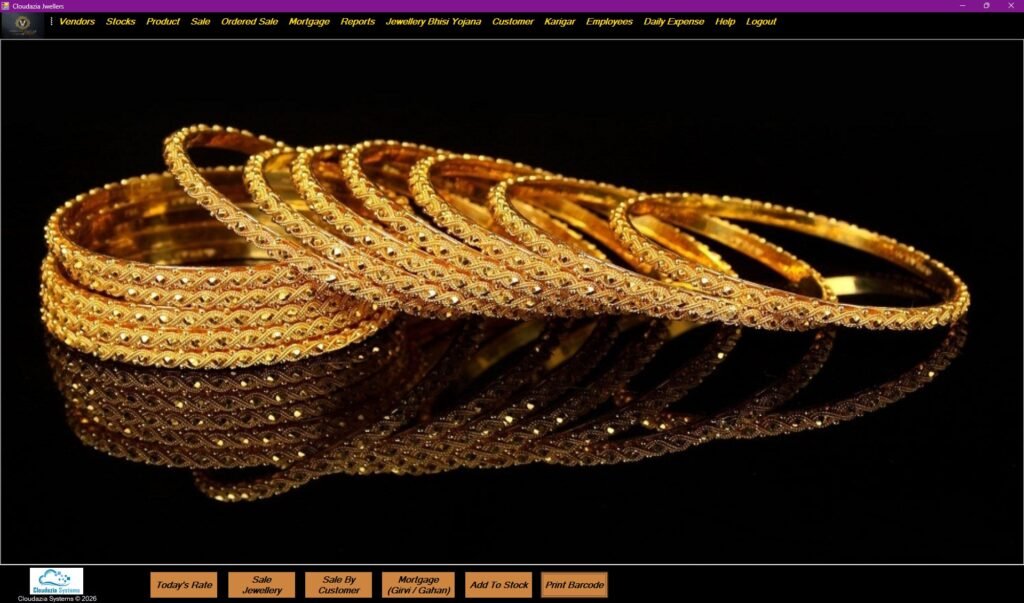
Our Retail Jewellery Management Software Main Dashboard
What Shop Owners Usually Notice First
Not a formal ROI table this time — just what actually gets mentioned in the first few weeks, based on how most single-store rollouts go:
- Billing is visibly faster within the first day, because the rate and making-charge math stops being manual
- Staff stop arguing over “what rate did we quote him” — there’s one system, one number
- The owner can check stock and daily sales from a phone instead of calling the shop
- GST filing stops being a weekend job
These aren’t dramatic transformations. They’re the small frictions that, removed, free up a surprising amount of the owner’s actual time.
Frequently Asked Questions About Jewellery Shop Software
Is jewellery shop software worth it for a single small store, or only for chains?
Single stores usually see the fastest payback, since rate accuracy and billing speed affect every transaction, every day, regardless of how many counters there are.
What’s the difference between billing software and full jewellery management software?
Billing software calculates a bill. Jewellery management software connects billing to inventory, mortgage, RD accounts, customer history, and GST reporting, so the shop runs from one system instead of a bill book plus a separate accounting entry.
Can jewellery shop software handle old gold exchange and Girvi/Gahan mortgage?
Yes, if it’s built for the Indian jewellery trade specifically. Old jewellery gets valued against the live market rate at exchange, and mortgage accounts calculate EMI and interest automatically — features that generic retail or accounting software typically doesn’t include.
How is jewellery management different for retail versus a growing multi-branch shop?
The core billing and rate logic stays the same. What changes is stock tracking (location-wise instead of shop-wide), staff access levels, and reporting across branches — which is why it’s worth choosing jewellery management software that supports multi-branch from day one, even if you’re only running one counter today.
How long does it take to set up jewellery shop software?
Most single-store retailers are billing on the new system within days of training, with stock history, mortgage accounts, and reporting phased in over the following weeks.
Get Jewellery Shop Software Built to Grow With You
If the bill book is still doing the work a proper system should be doing, it’s worth seeing what changes in the first week of switching. Cloudazia Systems builds jewelry management software for single-store and growing Indian retailers, with the same platform ready to extend into wholesale and bullion editions if the business ever needs that.
Book your free jewellery shop software demo and see it running on your own rate and billing scenario before deciding anything.