
Jewellery billing software should let you manage daily gold and silver rates, calculate making charges separately from metal value, apply the correct GST treatment, and update stock when you sell an item. If a billing tool cannot handle all four tasks on one invoice, it can cost you time at the counter every day.
That’s the short answer. The rest of this guide is about why each of those four things matters more in a jewellery shop than in almost any other kind of retail business, and what else is worth checking before you commit to a system.
Why Regular Billing Software Doesn’t Work for Jewellery
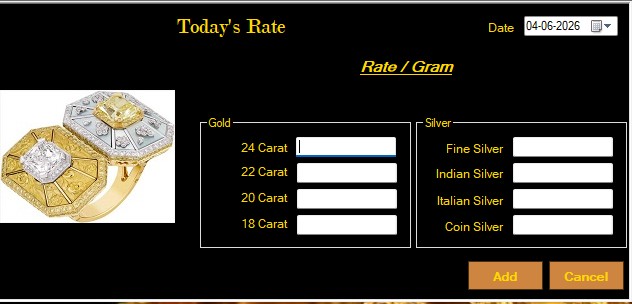
Our gold/silver rate management interface
Most billing software is built around a fixed price per item. You scan a barcode, the price comes up, you add tax, done. Jewellery doesn’t work that way. The same chain can have a different selling price depending on the gold rate that morning. The final invoice may include the metal value, making charges and applicable taxes. The software should calculate the correct GST on the transaction without making the billing process complicated.
A general-purpose billing tool may treat all these details as one price. A jewellery shop needs software that keeps each component clear and accurate.
Customers often check the numbers on a jewellery bill. An incorrect metal value, making charge or tax calculation can quickly affect their trust in the store.
What Should Jewellery Billing Software Include?
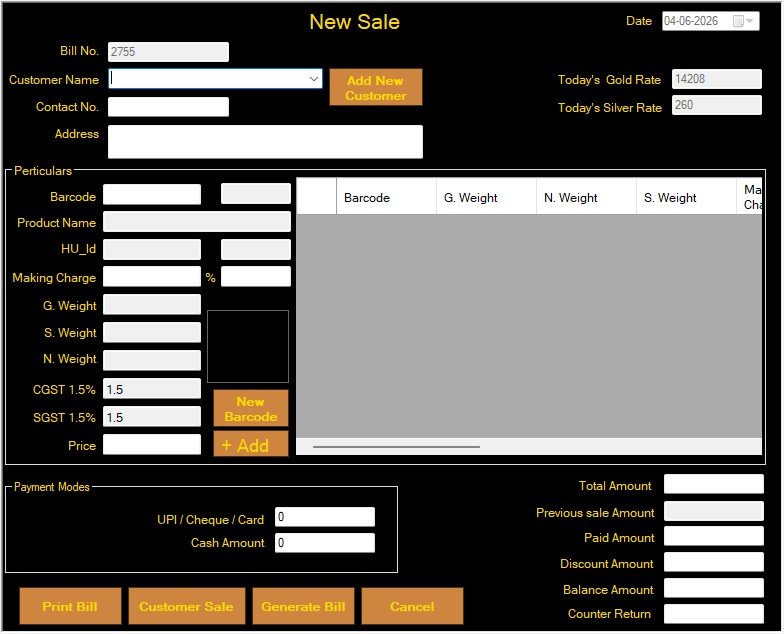
Our New Sale management interface
At minimum, your billing software should handle these tasks directly:
- Daily gold and silver rate management, so you can update rates when required and use the current metal price on each bill.
- Making charges shown separately, whether you charge a flat amount per gram or a percentage. This helps customers see what they pay for labour and metal.
- Correct GST calculation, with the applicable tax calculated on the jewellery transaction. The software should not split the retail transaction into separate GST rates for metal and making charges.
- Automatic inventory updates when you complete a sale, so your stock count stays in sync without a separate end-of-day update.
- Purity, fineness and HUID/hallmark details, where required or useful. These details help customers understand the jewellery and make future verification easier.
These features are related, but they should still be checked individually during a product demo, because different billing systems handle inventory and hallmark information differently.
How Does Jewellery Billing Software Handle GST Correctly?
For a normal retail sale of jewellery to the end consumer, GST is generally charged at 3% on the total transaction value of the jewellery, including making charges, whether those charges are shown separately on the invoice or not. The software should therefore calculate the applicable GST correctly on the jewellery transaction rather than applying separate GST rates to the gold value and making charges.
Jewellery falls under HSN code 7113, which currently carries 3% GST on the applicable transaction value (3% IGST, or 1.5% CGST plus 1.5% SGST for intra-state supply). Making charges can still be displayed separately for transparency. The 5% GST rate should not be presented as a separate retail making-charge rate; 5% can apply to certain job-work services in the jewellery sector. Retailers should verify the treatment applicable to their specific transaction with a qualified tax professional.
How Does Jewellery Billing Software Handle Jewellery Purity and Hallmarking?
Jewellery billing software should support recording purity, fineness and HUID information where required or useful. BIS states that mentioning the HUID number on the invoice is currently voluntary, while invoices for hallmarked precious-metal articles must include specified article and purity details.
Mandatory hallmarking applies to covered gold jewellery and artefacts in districts included under the applicable BIS mandatory hallmarking orders, subject to specified exemptions. The coverage has expanded through successive phases. BIS-recognised gold jewellery grades include 14K, 18K, 20K, 22K, 23K and 24K, subject to the applicable standard/order.
That verification step matters more than it used to. A customer can check a HUID themselves through the BIS CARE app, and a customer who can pull out their phone and check a hallmark against your invoice is a customer who trusts the shop more the next time they walk in. A shop whose billing software makes that easy to record isn’t adding extra work, it’s removing a reason for the customer to hesitate.
Jewellery Billing Software vs. General Retail Billing Software
| What it needs to do | General retail billing software | Jewellery billing software |
| Pricing basis | Fixed price per item | Metal rate + making charges + applicable taxes calculated per sale |
| Tax handling | Standard GST on the item price | GST calculated on the applicable transaction value of jewellery |
| Purity / hallmark tracking | Not applicable | Purity grade and HUID recorded per item |
| Inventory updates | By SKU count | By weight and piece, often across gold/silver/diamond separately |
| Rate changes | Rare, manual price list updates | Daily or even multiple-times-daily rate updates |
If you’re comparing full shop management systems rather than billing specifically, our guide on jewellery shop software for small and growing retailers covers how billing fits into the bigger picture of running day-to-day operations.
What Features Should I Look For in Jewellery Billing Software for My Shop?
Beyond the basics above, it’s worth checking three things most shop owners forget to ask about until after they’ve bought: whether the software can continue billing during an internet or power interruption, depending on how the system is deployed; whether it keeps a clean audit trail for every rate change applied to a bill; and whether it can print a GST-compliant invoice format rather than a generic retail receipt.
If you’re also managing multiple counters or need the billing data to feed into broader inventory and staff reporting, that’s really a jewellery management system question rather than a billing-software-alone question. The two overlap but aren’t quite the same decision. If you’re still comparing options, our guide on how to choose jewellery management software is a good next read. To see the product itself, explore Cloudazia’s jewellery management software.
FAQs
Can a software manage gold and silver rates?
Yes. This is one of the core things it needs to do differently from standard billing software. The system should let you update the day’s gold and silver rate centrally and have new bills use that rate, rather than you re-entering it on every sale.
Can it calculate making charges?
Yes, and it should calculate them as their own line item, separate from the metal value, whether you charge making charges as a flat rupee amount, a percentage of the gold value, or a per-gram rate. Keeping making charges separate can make the invoice easier for the customer to understand. However, for a normal retail sale of jewellery to an end consumer, GST is generally calculated at 3% on the total transaction value, whether making charges are shown separately or not.
Can a software handle GST on jewellery bills?
Yes. For a normal retail sale of jewellery to an end consumer, the software should calculate 3% GST on the total transaction value of the jewellery, including making charges whether they are shown separately or not. The software should apply the applicable GST treatment correctly rather than splitting the retail transaction into a 3% tax on metal value and 5% tax on making charges. Different GST treatment can apply to job-work services, so businesses should verify the treatment applicable to their specific transaction.
Can a software update inventory automatically after a sale?
It should. The stock count for an item (and its weight, if you track inventory by weight as well as piece count) should reduce when the invoice is generated, not as a separate end-of-day step, so your shelf count and your books never drift apart. Because systems handle this differently, confirm it during a demo.
Can a software handle different jewellery purities?
Yes. It should allow the business to record the applicable purity and fineness for each item and retain relevant hallmark information. BIS currently lists 14K, 18K, 20K, 22K, 23K and 24K grades for gold jewellery/artefacts under IS 1417. HUID information can also be recorded where useful, although BIS states that mentioning the HUID number on the invoice is voluntary at present.
Talk to Cloudazia About Your Billing Software Needs
Tell us how your shop bills today and what you want to fix. Our team will get back to you to discuss how Cloudazia’s jewellery management software can fit your workflow. Book Your Free demo.