
Scheme management software helps jewellery shops track customer instalments, payment history, running balances and scheme maturity dates in one place. Instead of relying only on registers or spreadsheets, a shop can use a digital system to organise records, review pending payments and calculate the benefits due under each scheme’s terms.
However, not every jewellery scheme works in the same way. Some customers pay a fixed amount every month, while others may follow a different deposit schedule or receive a benefit when they redeem their scheme. A suitable system should let the shop record these rules clearly and calculate the customer’s balance according to the agreed terms.
In this guide, we’ll explain how scheme management software works, which features to check before choosing a system, how it differs from Girvi/Gahan recordkeeping, and what jewellers should consider when connecting scheme records with billing.
What Is Scheme Management Software?
Scheme management software is a tool for recording and managing customer payment schemes offered by a jewellery business. These schemes may allow customers to make regular payments towards a future jewellery purchase, subject to the shop’s written terms and conditions.
The system should help staff answer practical questions without searching through several registers:
- How much has a customer paid so far?
- Which instalments are still pending?
- What is the current balance?
- When does the scheme mature?
- What benefit, if any, applies at maturity?
- What are the redemption conditions?
- Has the customer redeemed the scheme or is it still active?
By keeping this information together, the shop can review each account more consistently. Staff can also refer to a payment history when a customer asks about a previous instalment or the amount available for redemption.
The key point: the software should record and calculate the scheme according to its actual terms. It should not assume that every scheme offers the same duration, bonus or redemption benefit.
What Types of Customer Schemes Can Jewellery Software Manage?
Jewellers may offer different scheme formats depending on their business model. Before choosing software, identify the types of schemes your shop actually runs.
1. Fixed monthly instalment schemes
Under this format, a customer pays a set amount at regular intervals for a defined period. The software should record each payment, show the instalments received and identify any that remain pending.
2. Flexible deposit schemes
Some arrangements may allow customers to deposit different amounts over time. In this case, the system should maintain an accurate running total and preserve the history of each payment.
3. Schemes with a bonus or maturity benefit
Certain schemes may provide an additional benefit at maturity. The benefit could depend on the scheme’s specific terms, so the software should apply the correct rule rather than use one default calculation for every customer.
4. Different scheme durations and redemption conditions
A jewellery shop may need to manage more than one scheme at a time. Check whether the software can store different start dates, payment schedules, maturity dates and redemption rules without requiring staff to maintain separate spreadsheets.
Before activating any scheme, document its duration, payment conditions, benefits, cancellation or refund rules, and redemption terms. Ask the software provider to demonstrate how these rules are recorded and applied.
How Does Scheme Management Software Track Payments and Balances?
Every payment should be recorded against the correct customer and scheme. The record should include the payment date, amount, receipt or reference number, and the employee or user who recorded it, where the system supports that level of tracking.
The running balance should update according to the payment received. Staff should also be able to review earlier entries rather than seeing only a final total.
For example, imagine a customer pays ₹2,000 each month into a scheme. After five successful payments, the recorded amount paid would be ₹10,000. This is an illustrative calculation, not a standard jewellery scheme or a promise of any maturity benefit.
A suitable system should make it easy to verify those five payments and identify the date and amount of each one. If a payment is corrected, reversed or entered by mistake, the shop should be able to follow the record of that change where the software provides an audit trail.
This matters because payment disputes can arise when a receipt is misplaced or a register entry is unclear. A complete payment history helps staff investigate the issue and explain the balance using recorded information.
Features to check for payment tracking
- Customer-wise and scheme-wise payment history.
- Automatic running-balance calculation after recorded payments.
- Receipts or payment references that staff can retrieve later.
- Clear identification of pending instalments.
- A way to correct errors without losing the history, if supported.
- Access controls for employees who record or modify payments.
- Reports that help staff review active schemes and outstanding instalments.
During a product demonstration, ask the provider to record a payment, show the updated balance, retrieve the receipt and correct a test entry. This is more useful than relying only on a feature list.
How Does Scheme Management Software Calculate Maturity Amounts?
The maturity amount depends on the scheme’s agreed terms. It may reflect the total payments received and any eligible bonus or other benefit. The calculation should follow the rules communicated to the customer when they joined the scheme.
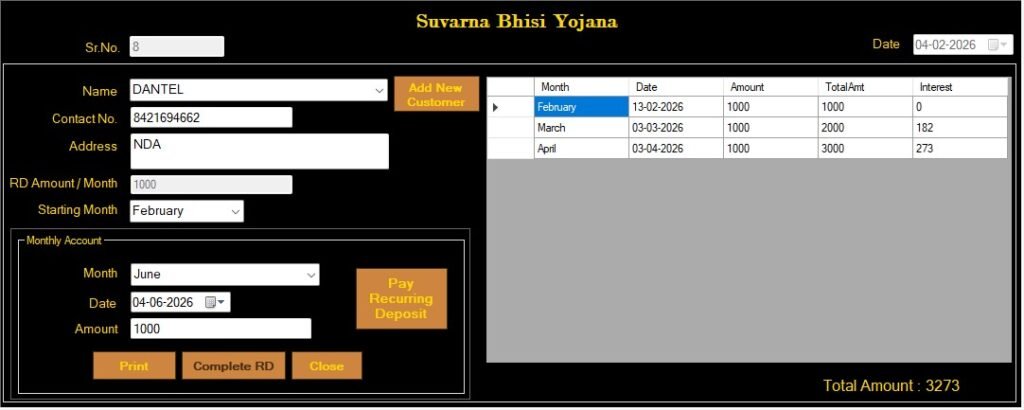
Our jewellery management software RD SCHEME dashboard
For instance, suppose a hypothetical scheme requires 11 monthly payments of ₹2,000 and provides an additional benefit equal to one instalment. If the customer meets all the scheme conditions, the total paid would be ₹22,000 and the illustrative benefit would be ₹2,000. The resulting scheme value would be ₹24,000, subject to the scheme’s actual terms.
This example is only for explaining the calculation. It does not mean all jewellery schemes use an 11-month schedule or provide an additional instalment.
Before choosing software, check whether it can:
- Store the scheme’s payment schedule and benefit rules.
- Calculate the total amount paid.
- Apply the correct benefit when the customer qualifies.
- Display the maturity date and calculated value.
- Record whether the scheme has been redeemed.
- Preserve a record of the redemption and any remaining balance.
Staff should be able to explain the maturity calculation using the scheme’s recorded terms and payment history. If a system calculates a benefit automatically, confirm that an authorised user can review the calculation before redemption.
Why Should Jewellers Track Scheme Due Dates and Terms Carefully?
Customer schemes involve money received in advance for a future purchase. That makes clear documentation and accurate records important—not just for convenience, but also for customer communication and business administration.
The legal treatment of an advance-payment arrangement can depend on the business structure, the terms of the scheme and the applicable law. For example, the Companies (Acceptance of Deposits) Rules, 2014 include a provision concerning certain advances for goods or services that are adjusted within 365 days. This should not be interpreted as a blanket rule that applies identically to every jeweller or every scheme.
The Banning of Unregulated Deposit Schemes Act, 2019 is also relevant to the wider legal framework around unregulated deposit schemes, but a scheme’s status cannot be determined simply by looking at its duration alone.
For this reason, jewellers should obtain advice from a qualified legal or accounting professional before launching or changing a customer scheme. The software can help maintain records and highlight dates, but it cannot by itself guarantee legal compliance.
From an operational perspective, look for a system that can record:
- Scheme start and maturity dates.
- The written terms and applicable benefit structure.
- Payment history and outstanding instalments.
- Redemption, cancellation or refund status, as applicable.
- Relevant notes and supporting references.
- Reports that help staff identify schemes approaching maturity.
Reliable records help the business answer customer questions and review each scheme against its documented conditions.
What Is Girvi/Gahan Record keeping, and How Is It Different From Customer Schemes?
Girvi or Gahan is a term used in some regions for an arrangement involving gold or other valuables pledged as security. The precise arrangement and applicable requirements can vary, so jewellers should document the transaction and check the rules relevant to their business.
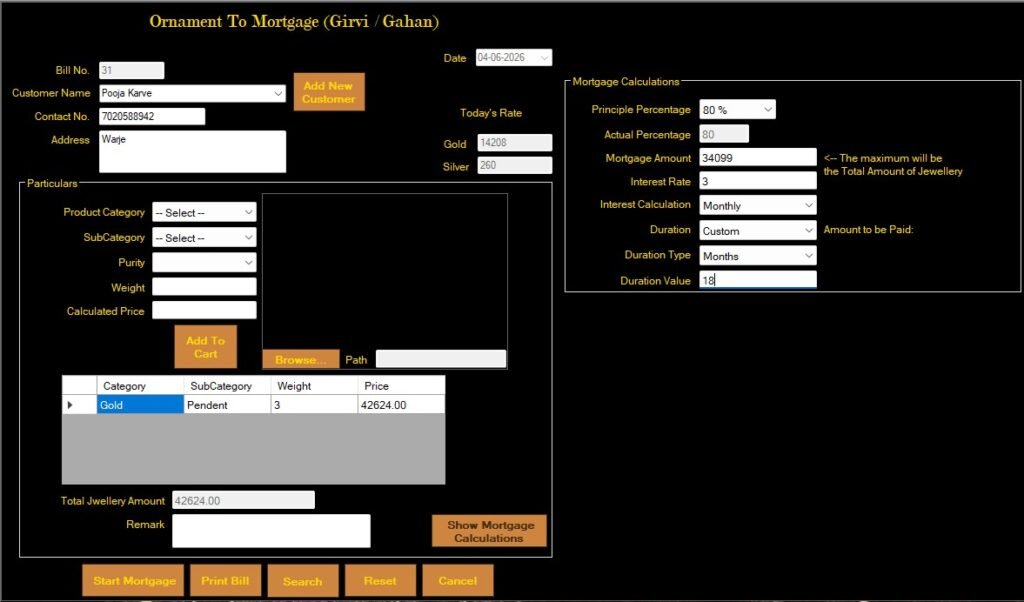
Our jewellery management software Mortgage/Girvi dashboard
A customer payment scheme and a Girvi arrangement serve different purposes. In a customer scheme, the shop records payments towards a future purchase under agreed conditions. In a Girvi arrangement, records may need to cover pledged items, valuation details, the amount advanced, applicable charges or interest, repayment terms and the return of the pledged items.
Because the records are different, one generic customer balance may not be enough to manage both workflows properly.
If your business handles Girvi/Gahan transactions, ask whether the software can maintain the relevant records separately. Check whether it can capture item descriptions, weight and purity where relevant, valuation details, transaction dates, repayment history and the status of the pledged items.
Do not assume that every jewellery management system includes a dedicated Girvi module. Ask the provider to demonstrate the exact workflow and confirm which features are included in the product you are considering.
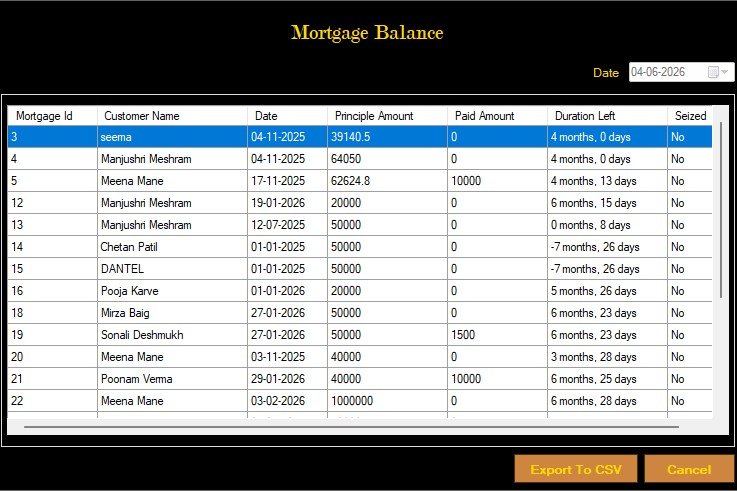
Our jewellery management software Mortgage/Girvi Balance dashboard
Manual Register vs. Scheme Management Software
Both a register and a software system can hold customer information. The practical difference is how easily staff can retrieve, verify and update that information as the number of active schemes grows.
| Task | Manual register or spreadsheet | Software to look for |
|---|---|---|
| Payment records | Staff enter and review entries manually | Customer-wise payment history |
| Running balance | May need manual recalculation | Balance recalculation after a payment is recorded |
| Maturity date | Staff check dates against records or calendars | Maturity-date tracking and reminders, if supported |
| Pending instalments | Staff review each account | Reports or alerts for pending payments, if supported |
| Scheme terms | May be stored separately | Scheme rules recorded with the account |
| Redemption | Staff may recheck several records | Redemption record linked to the scheme, if supported |
| Access and corrections | Depends on the register or file process | User permissions and change history, if available |
The table describes capabilities to compare, not a guarantee that every software product includes every feature. Confirm each requirement during a demonstration.
If you also want to understand the billing side of a scheme redemption, read our guide to jewellery billing software. It explains the billing features to consider when generating jewellery invoices.
Can Scheme Management Software Integrate With Jewellery Billing?
Integration can reduce repeated data entry when a customer redeems a matured scheme. However, the exact workflow depends on the software and the way the shop processes redemptions.
In an integrated workflow, staff should be able to identify the customer’s scheme, review the eligible amount under its terms and apply that amount to the relevant transaction. The system should also retain a record of the redemption so the shop can review the scheme balance and invoice later.
Without integration, staff may need to copy details between the scheme record and the billing system. That creates an additional opportunity for transcription errors and makes reconciliation more time-consuming.
Before buying, ask the provider to demonstrate a complete test scenario:
- Open an active customer scheme.
- Review its payment history and maturity conditions.
- Calculate the amount eligible for redemption.
- Apply the eligible value to a test invoice, if the integration supports it.
- Confirm how the redemption appears in both the scheme record and billing record.
- Review what happens if the invoice is cancelled or corrected.
Also ask whether the integration is included in the quoted price, requires configuration or depends on a particular software edition.
For a broader overview of software needs beyond customer schemes, see our guide to jewellery shop software for small and growing retailers.
What Should a Jeweller Check Before Choosing Scheme Management Software?
A feature list is a useful starting point, but a practical demonstration is the best way to see whether the system fits your shop’s workflow.
Use this checklist when comparing providers:
- Scheme setup: Can you configure the durations, instalments and benefits that your business actually offers?
- Payment accuracy: Can staff record payments and retrieve a complete history?
- Maturity calculation: Does the system calculate the value according to the scheme’s terms?
- Pending-payment review: Can you identify unpaid instalments and upcoming maturity dates?
- Customer communication: Can staff access accurate payment and scheme information when customers ask questions?
- Redemption records: Can the system record the redemption and link it to billing, if required?
- Girvi/Gahan workflow: If your business needs it, can the system maintain separate pledge and repayment records?
- User permissions: Can you control who may record payments, correct entries or change scheme terms?
- Reports and exports: Can you retrieve the information needed for reconciliation and business review?
- Support and training: What onboarding, training and after-sales support does the provider include?
A useful demonstration should follow a real-world workflow rather than show only a dashboard. Ask the provider to set up a sample scheme, record payments, review its maturity amount and process a test redemption.
Finally, confirm the product edition, setup requirements, integration costs and any features that require additional configuration. This helps you compare solutions based on your actual needs instead of assumptions.
Frequently Asked Questions
How can scheme management software help a jewellery shop manage customer schemes?
It automates the three things a shop would otherwise track by hand: how much each customer has paid, what their scheme is worth at any point, and when it matures. For a shop running schemes across hundreds of customers, that removes the single biggest source of manual error — a missed or mis-recorded instalment.
How can jewellery software track monthly scheme payments?
Look for a system that records each payment against the correct customer and scheme, updates the running balance and preserves the payment history. Ask the provider to demonstrate how staff can retrieve receipts and review corrections.
Can scheme management software calculate maturity amounts?
It can if the product supports the scheme’s calculation rules. Confirm that it records the total payments, applies the correct eligible benefit and displays the maturity amount according to the written terms.
Can software track overdue instalments and maturity dates?
Some systems provide due-date reports, reminders or alerts. Confirm which options are available, how staff receive notifications and whether the rules can be configured for your scheme formats.
Is Girvi/Gahan management the same as customer scheme management?
No. Customer schemes track payments towards a future purchase, while Girvi/Gahan records relate to pledged valuables and the associated transaction. A jeweller who needs both should confirm that the software supports each workflow separately.
Can scheme management software connect with jewellery billing software?
Some systems support this workflow, but integration varies. Ask the provider to demonstrate how a matured scheme value is applied to an invoice and how both records are updated after a redemption or correction.
What should a jeweller check before choosing scheme management software?
Check scheme configuration, payment tracking, maturity calculations, due-date reports, redemption records, user permissions and billing integration. Also review the provider’s training, support and pricing. Legal or tax questions about your scheme should be checked with a qualified professional.
Conclusion
A suitable scheme management system should help jewellery shops maintain accurate customer payment records, calculate balances according to agreed terms and review maturity dates without depending entirely on manual registers.
Before choosing a product, test the complete process—from setting up a scheme and recording instalments to calculating the eligible maturity value and handling redemption. If your shop also manages Girvi/Gahan transactions, confirm that those records are supported separately.
The right choice is the system that fits your shop’s actual processes, gives staff reliable information and makes customer transactions easier to review and explain.
Looking for Scheme Management Software for Your Jewellery Business?
Managing customer instalments, maturity dates and Girvi records can become difficult as your jewellery business grows. Contact Cloudazia Systems to discuss your business requirements and explore which jewellery software workflows may suit your needs.